Is your bank still shouting from roof-top?
Traditionally banks have relied mainly on the conventional mediums like print, television, radio and postal mails for marketing. With shift in the focus of banks to go digital, banks have also started direct marketing which is reaching customers mainly through SMS, emails, mobile or web channels but still the strategy followed is mainly of broadcast marketing.
As per the 2015 Gartner CMO spend survey, the digital marketing budget averages only a quarter of the total marketing budget. Also within that only around 18% is allocated to mobile and email marketing as per the 2013 Gartner Digital Marketing survey.
So with direct marketing not being top investment area of marketing budget, it becomes even more imperative to see that the budget is effectively spent. To determine the effectiveness of the direct marketing strategy, the questions to ask are:
“Is your bank mainly living in the age of broadcast marketing?”
“Is personalized marketing not a focus area for your bank?”
“Does your bank mainly believes in cold calling customers?”
“Is real-time marketing still a distant dream for your bank?”
If the answer to any of the above questions is a YES, your bank needs to rethink its digital marketing strategy. But, the fact is, you are not alone. Although there is lot of ground to cover still most banks have some way to go before they can claim to have setup a mature digital marketing strategy.
Digital Marketing Maturity Model
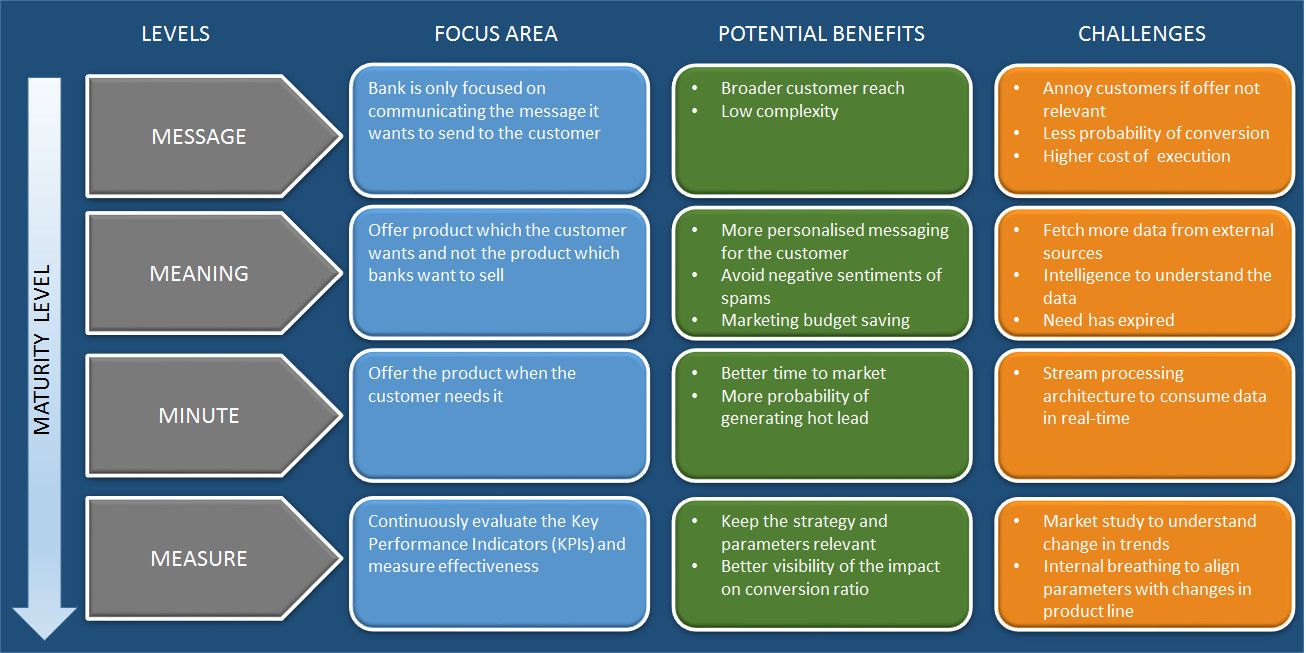
To better understand the maturity of digital marketing strategy of the banks, it can be classified as per the following 4M maturity model:
- Level 1 – Message: Generally all the banks are involved in broadcast marketing through cold-calling or direct marketing channels like emails or SMS notifications focusing only on message to be communicated. The customers are shortlisted by segmentation done at a very high level by considering static or near static parameters like age, gender, occupation, salary which are either constant or are at least not very dynamic. Another form of broadcast marketing is through banners and advertisements which are again more based on the marketing platform rather than the customer requirements.
- Level 2 – Meaning: Next maturity level of digital marketing is Personalized Marketing wherein the banks are considering the requirements of individual customer and offering the targeted products. The message needs to have some meaning for the customer. The key issues in personalized marketing is that besides the transaction and profile information, the rest of the data needed for creating 360 degree view of the customer for personalization is not available within the IT landscape. The bigger problem though is that mostly banks are not even analysing the transaction data to provide personalized marketing products
- Level 3 – Minute: In today’s scenario even the targeted customer interaction is not enough to generate effective lead. The decision making of customers has increased many fold thus reducing the overall purchase cycle time. There is no point in making an offer to the customer if he has fulfilled the requirement. For example, if a customer was to travel abroad and you wanted to offer travel insurance to him, there is no use of selling the insurance if the customer has already purchased it or worst case is already back from his trip
- Level 4 – Measure: Having setup an automated digital marketing system to handle data from various sources and generating automated personalized notifications will not generate lead to its potential. We need to measure the effectiveness of the system and evaluate the Key Performance Indicators (KPIs) for configuring event based triggers
If you are a retail bank and at the highest maturity level then you are definitely in a niche place but if you are still heavily invested only in broadcast marketing then you need to reconsider your marketing strategy. The subsequent sections would help you in identifying the factors which can assist you in your future course of action.
What is the way forward?
Personalized Marketing
The most crucial factor to drive the personalized marketing is
“DATA”
Banks need to have a 360 degree view of customer before they can command confidence in understanding his needs. The good part is that banks are already sitting on a wealth of information of the customers though not harnessed to potential. They have the profile information, account transaction data, product investments, credit card purchases, and much more.
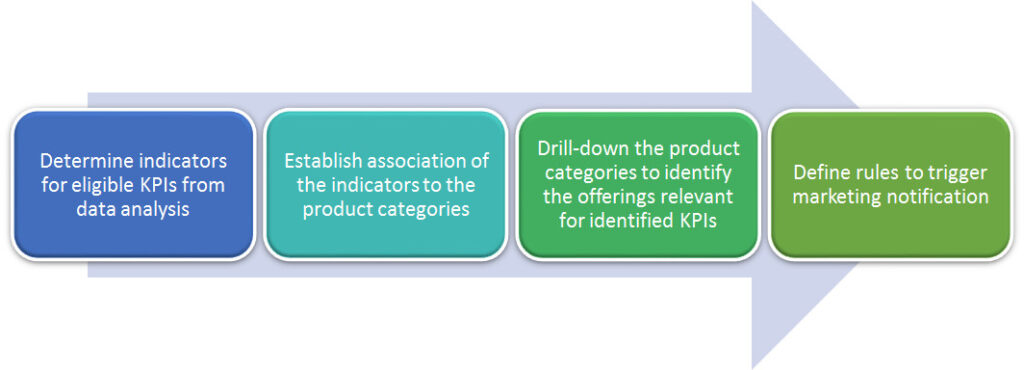
The high-level process for data analysis for targeted marketing is outlined as:
Once you have matured the personalised marketing process with the in-house data, you need to expand your reach of the customer data. This is also one of the biggest challenge as currently most of the data generated by the customers is on social networking sites which is outside your IT landscape.
Before you dive into integrating with any social platform you first need to identify what use cases you are trying to address with your solution. Depending on the use case you would be able to identify the life events which you would use as triggers to generate marketing offers. This would help you in determining what all social platforms you need to integrate with.
A very common use case of social analytics is if a customer posts on his Facebook wall regarding birth of his child, he can be offered health insurance, child education plans, child marriage plans, etc. other such products.
Another use case is if a customer tweets that he would be travelling abroad. Based on this information the customer can be offered a travel insurance, cash card, or even credit cards beneficial for frequent flyers.
The personalized marketing is essential as it addresses the
“WHAT”
of the customer need. You are offering what the customer needs and not just what you want to sell. Considering customer need in offering product is more likely to generate a hot lead.
Even if the lead doesn’t generate a conversion, it would still help in reducing the negative sentiments of your customer from all the spam email and marketing calls.
Event-driven Personalized Marketing
As we have discussed in the previous section, just focusing on personalized marketing is not sufficient. We need to be able to make the offer as well as time the offer so that our offer can stay relevant for the customer. Consider our previous example, if we offer child education plan to a customer who has already purchased similar product from your competitor, would your offer still be relevant.
The crucial factor at this stage is not only DATA but
“PROCESSING”
of data.
It is not just enough to dump all your data in a data warehouse and do offline processing and come back with the results and actions in days, weeks or months. What we need is streaming analytics so that we are able to process the data and generate actions in near real-time. With huge amount of data being generated in-house as well as across integrated data sources, the biggest challenge is to have IT infrastructure in place to consume, process and analyse all the data.
The marketing needs to be more real-time as it addresses the
“WHEN”
of the customer. You are to be having conversation with the customer when he is in need for having it and not when you want to have it.
Governance
Once you have the infrastructure in-place to process all the data and have an effective event driven personalized marketing strategy, to continue to keep it effective you need to have effective feedback loop. This whole process is not a one-time activity but a continuous process so it has to be periodically evaluated and optimized to keep the factors relevant. Additionally as the bank grows in its product offerings or with time more external data sources are created, the whole system needs to be periodically analysed and refactored.
Webinar
If you are further interested in the topic of helping banks in achieving real-time personalised marketing, there is a webinar planned by BFSI unit of Nagarro to discuss this topic in more depth.
Click on the following links to register for the webinar based on your convenient time zone.
<Link Removed as the Webinar was in past>
This blog was first published on LinkedIn.